August 22, 2025 | Lynn Reed Insights
A Guide For Communication Challenges in Hybrid Work
The single biggest problem in communication is the illusion that it has taken place.
– George Bernard Shaw

Have you ever left a meeting thinking everyone was on the same page, only to realize later that a crucial message was missed? In a hybrid work environment, this isn’t just common, it’s a critical challenge. The stakes are high: poor communication can lead to disengaged employees, low team morale, and reduced performance. Consider this real-world example:
Situation: A senior leadership team managing IT risk in a large European bank was having severe communication issues driven by strong personalities and the impact of cultural differences within the team. Locations represented by team members included the USA, UK, Continental Europe and Asia/Pacific.
Complication: Utilizing technology that enabled the next best thing to in-person dialogue (video-conferencing, at the time), the team experienced long, painful debates (ranging up to six hours in length across multiple global time zones) on key strategic issues which many found to be very frustrating and demotivating. The team leader was on the verge of firing people due to the lack of effective communication and disconnects occurring in their hybrid environment.
Solution: We introduced the team to an alternative thinking / communication methodology based on parallel thinking (The Six Thinking Hats), along with facilitated sessions to apply the technique. The result? The team’s collaboration and cooperation improved dramatically. Meeting and decision-making times were cut by more than 50%, and nobody got fired.
This success wasn’t accidental. It came from understanding what truly makes communication effective in a hybrid world. Engaged employees are the cornerstone of a successful organization, and a strong sense of purpose in their work drives them to go above and beyond. But engagement hinges on effective communication, which is often a challenge in a hybrid environment. So, what can you do to fix it?
In our example, implementing The Six Thinking Hats with expert guidance and application coaching was key. The method provides a structure that segments the thinking into different types of thinking (facts and information, creative ideas, benefits, barriers, intuition and managing the thinking) – everyone stays focused on one aspect of the thinking at a time.
The result is equal participation for all, less debate and more thorough examination of all aspects of the decision process – leading to high levels of engagement and buy-in. Opening the door to creative thinking is another significant benefit for most organizations.
Essential Communication Skills and Strategies for Hybrid Teams
Efficient communication (fast and cheap) isn’t the same as effective communication (a message received as the sender intended). Much of today’s technology focuses on efficiency, not effectiveness. To bridge this gap, follow these essential steps:
1. Clarify the Objective: Before you communicate, know your purpose. This may sound simple, but it’s often overlooked and leads to unnecessary ambiguity and confusion, ultimately driving down engagement and trust. Is your goal to:
-
- Inform (share facts, a new strategy, or feedback)?
- Build relationships and trust?
- Solicit input (feedback or creative ideas)?
- Solve problems and make a decision together?
- Something else?
As part of setting your objective, consider your target audience and the proper balance between efficiency (like an email blast) and effectiveness (engaging in a dialogue).
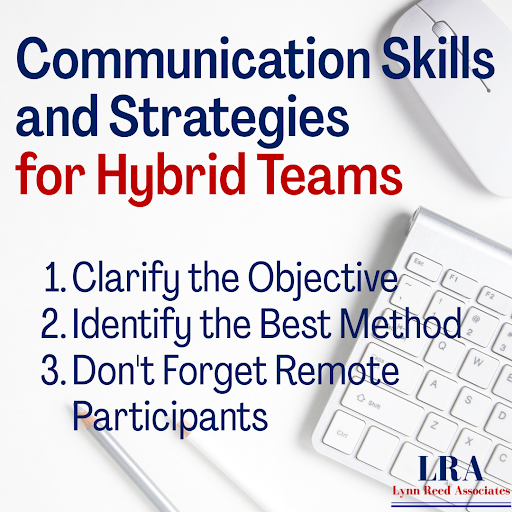
2. Identify the Best Method: Once your objective is clear, select the best medium. For example, are you:
-
- Sharing facts with a large audience? An email would suffice.
- Changing a scheduled appointment? A text or call works.
- Discussing an individual’s annual performance appraisal? An in-person or virtual meeting is a must.
- Developing teamwork and cooperation? Again, an in-person or virtual meeting is required.
3. Don’t Forget Remote Participants: You need to ensure remote team members feel as engaged as those who are physically present. A good leader will address the complexities of different time zones, languages, cultures, and the awkwardness of communicating through a camera and microphone.
The Importance of Building Trust and Engagement in Remote and Hybrid Teams
For years, we’ve found that one of the most significant barriers to effective communication is the over-reliance on technology that removes the human element. The majority of communication happens through nonverbal cues.
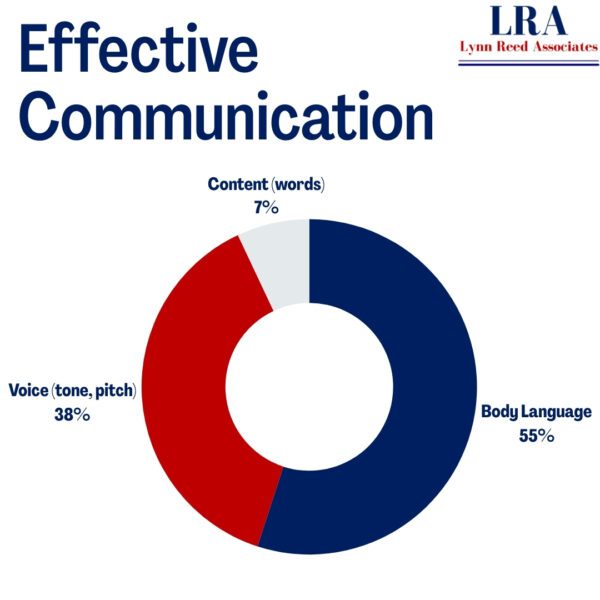
A former professor of psychology at UCLA, Albert Mehrabian, developed the 7-38-55 rule of communication, which breaks down the components of effective communication:
- Body language = 55%
- Voice (tone, pitch) = 38%
- Content (words) = 7%
This model highlights why texting and social media, which focus only on the 7% (content), can lead to so many misunderstandings. As a surrogate for emotion, emojis have become commonplace to fill this gap. A phone call brings the number up to 45%, but you’re still missing the crucial 55% of body language, of which eye contact is the most important factor globally.
To effectively engage remote team members for important conversations, you must utilize virtual meeting technology (like Zoom or MS Teams) and ensure everyone has their webcams on the entire time; this makes up the “missing 55%”. We like to say this is less a suggestion and more of a rule—like how we “suggest” you pull the ripcord after jumping out of an airplane.
Our experience working with a global bank provided insights into this. Many people complained that team meetings weren’t effective—some were distracted, others weren’t listening—because critical conversations were often held on conference calls or virtual meetings where participants turned off their webcams. They were losing 55% of the dialogue!
Insist on Webcams: No Excuses.
They will quickly get used to it, stay focused on the meeting content, and are encouraged to engage despite the initial awkwardness of seeing themselves on the screen. Strong leaders can create and build trust with remote employees by consistently following this suggestion.
Overcoming Communication Barriers in a Hybrid Environment
While the steps above will dramatically improve communication, other barriers can get in the way. For thousands of years, most group problem-solving has been based on an adversarial thinking style—an “I win, you lose” mentality. Additionally, personality types (e.g., Introverts vs. Extroverts) and emotional intelligence play a major role in the quality of communication.
These are just a few of the deeper challenges we help teams address. Our extensive experience as trusted advisors to global teams for over 25 years has uniquely positioned us to offer expert advice on maximizing communication in any environment. This blog is the first in a series that will delve into these critical topics.
Ready to transform your team’s communication? Read our next blog post to learn how to apply strategies like The Six Thinking Hats and personality type assessments to your team!